

Many Intermediate students face immense anxiety before their physics practical exams. Unlike the theoretical paper, the laboratory exam tests your precision, manual circuit-building skills, graphical plotting accuracy, and quick thinking during oral evaluations.
To eliminate confusion and ensure you secure a perfect score, this expert-backed guide breaks down the official BISE Lahore Board Physics Practical paper pattern, details the must-know experiments, provides worked examples for the trickiest graph questions, and shares high-yield examiner secrets.
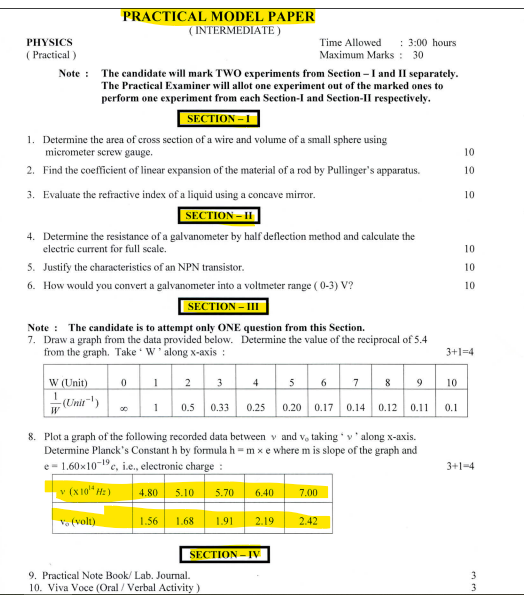
Section 1: Physics Practical Exam Structure
The Intermediate Physics practical paper lasts 3 hours and carries a total weight of 30 marks. The paper is balanced between mechanical/optical setups, electronic circuit mastery, coordinate geometry plotting, and oral performance.
The Exam Timeline & Rules
- The Selection Rule: On your answer sheet, you must write down two experiments from Section I and two experiments from Section II.
- The Examiner’s Choice: The on-duty practical examiner will choose one experiment from each section for you to actually perform at your laboratory station.
Section 2: Complete Paper Breakdown & High-Yield Analysis
Section I: Mechanics, Optics, and Thermal Properties (10 Marks)
This section assesses your ability to use analog measurement tools, manage thermal physics equipment, and calculate optical properties with precision.
🎯 High-Priority Experiments (Guest List):
- The Micrometer Screw Gauge: Determine the cross-sectional area of a thin wire ($A = \pi r^2$) and the volume of a small solid sphere ($V = \frac{4}{3}\pi r^3$).
- Pullinger’s Apparatus: Determine the coefficient of linear expansion ($\alpha$) of a metallic rod.
- Concave Mirror Method: Evaluate the refractive index ($n$) of an unknown liquid.
⚠️ Common Error Alert: When using the Micrometer Screw Gauge, always check for Zero Error before starting your calculations. If the zero line of the thimble scale does not align with the datum line of the main scale when the anvil and spindle meet, note down whether it is a positive or negative zero error and apply the correction factor to your final readings.
Section II: Current Electricity & Electronics (10 Marks)
This section demands clean wiring setups and a solid grasp of circuit diagrams. A single misplaced jumper wire can cause a component to fail or give incorrect readings.
🎯 High-Priority Experiments (Guest List):
- Half-Deflection Method: Find the internal resistance ($R_g$) of a galvanometer and calculate its figure of merit.
- Galvanometer Conversion: Modify a standard galvanometer into a functional voltmeter with a specific range (e.g., $0-3\text{ V}$) by connecting a high resistance ($R_h$) in series.
- NPN Transistor Characteristics: Wire a transistor circuit to map and justify its input/output current-voltage relationships.
          Standard Galvanometer-to-Voltmeter Conversion

               [ Galvanometer (Rg) ] ---- [ High Resistance (Rh) ]
               |_________________________________________________|
                                        |
                             Connected in Series
Section 3: Section III Solved — Master the Graph Questions (4 Marks)
You are required to attempt only ONE graph question in this section. To prevent your content from looking like a simple copy of the board syllabus, let’s look at exactly how to solve these problems mathematically on your graph sheet.
Option A: Graphing $W$ vs. $\frac{1}{W}$ (Inverse Relationships)
This graph tests your ability to map an asymptote-style curve or its linear inverse representation. When plotting $W$ along the x-axis and $\frac{1}{W}$ along the y-axis, the points form a perfectly smooth downward hyperbola.
📈 Master Data Set:
- $W$ Values: $1, 2, 3, 4, 5, 6, 7, 8, 9, 10$
- $\frac{1}{W}$ Values: $1.0, 0.50, 0.33, 0.25, 0.20, 0.17, 0.14, 0.12, 0.11, 0.10$
🧠 How to find the reciprocal of $5.4$ from your plotted curve:
- Locate the value $5.4$ on your horizontal X-axis ($W$).
- Use a ruler to draw a straight, vertical dashed line upward until it intersects your plotted curve.
- From that exact intersection point on the curve, draw a horizontal dashed line directly to the left until it hits your vertical Y-axis ($\frac{1}{W}$).
- Your line will hit exactly at $0.185$. This proves that $\frac{1}{5.4} \approx 0.185\text{ Unit}^{-1}$.
Option B: Photoelectric Effect & Planck’s Constant ($h$) Calculation
This is a highly popular option chosen by top-tier students. It proves the Einstein Photoelectric Equation by deriving a fundamental constant of nature from the slope of a line.
📊 Plotted Data Set:
| Frequency ν (×1014 Hz) | Stopping Potential V0 (Volt) |
| 4.80 | 1.56 |
| 5.10 | 1.68 |
| 5.70 | 1.91 |
| 6.40 | 2.19 |
| 7.00 | 2.42 |
📐 Step-by-Step Calculation Formula:
When you plot Frequency ($\nu$) on the X-axis and Stopping Potential ($V_0$) on the Y-axis, you will get a straight line that slopes upward.
$$\text{Slope } (m) = \frac{\Delta V_0}{\Delta \nu} = \frac{2.42 – 1.56}{(7.00 – 4.80) \times 10^{14}} = \frac{0.86}{2.2 \times 10^{14}} \approx 3.91 \times 10^{-15}\text{ V}\cdot\text{s}$$
Now, multiply your calculated slope ($m$) by the fundamental charge of an electron ($e = 1.60 \times 10^{-19}\text{ C}$):
$$h = m \times e = (3.91 \times 10^{-15}\text{ V}\cdot\text{s}) \times (1.60 \times 10^{-19}\text{ C}) \approx 6.25 \times 10^{-34}\text{ J}\cdot\text{s}$$
(Note: This matches close to the true theoretical value of Planck’s Constant: $6.63 \times 10^{-34}\text{ J}\cdot\text{s}$, verifying your experimental accuracy).
Section 4: Securing the Lab Notebook & Viva Voce Marks (6 Marks)
The final 6 marks are divided evenly between your practical notebook (3 Marks) and the face-to-face Viva Voce (3 Marks).
📓 The Perfect Lab Journal Checklist:
- Your notebook must be completely filled out, with blank graph pages fully drawn with pencil.
- Every single experiment must feature a calculated Least Count (L.C.) block at the top of the page.
- The Absolute Rule: Your college physics professor must sign and stamp the index page. An unsigned workbook can result in an automatic deduction of these marks.
Also Read More About: Biology Practical Model Papers Lahore Board
🎙️ The Examiner’s Secret Viva Vault
The oral examiner wants to know if you actually built the circuits yourself or if you simply memorized the answers.
Top 5 Viva Questions Asked in Lahore Board Centers:
- Q: What is the Least Count of a standard Vernier Caliper and a Micrometer Screw Gauge?
- Answer: For a standard Vernier Caliper, it is $0.1\text{ mm}$ ($0.01\text{ cm}$). For a standard Micrometer Screw Gauge, it is $0.01\text{ mm}$ ($0.001\text{ cm}$).
- Q: Why is a very high resistance connected in series when converting a galvanometer into a voltmeter?
- Answer: A voltmeter must have high ideal resistance so that it draws negligible current from the primary circuit, ensuring it measures the true potential difference across two points without dropping the voltage.
- Q: What does the slope of a Stopping Potential vs. Frequency graph represent?
- Answer: The slope represents the ratio of Planck’s constant to the elementary charge ($\frac{h}{e}$).
- Q: What is the purpose of using a resistance box in a half-deflection method experiment?
- Answer: It allows us to introduce a known, precise resistance into the circuit to reduce the galvanometer’s initial full-scale deflection to exactly half.
- Q: What is the difference between linear expansion and volumetric expansion?
- Answer: Linear expansion ($\alpha$) measures the change in a material’s length per unit temperature change, while volumetric expansion ($\gamma$) measures the change in its total volume. ($\gamma = 3\alpha$).
Actionable Tips for Exam Day
- Bring Your Tools: Always carry a sharp pencil, an eraser, a transparent plastic ruler, and a non-programmable scientific calculator. Sharing tools is strictly forbidden inside Lahore board exam halls.
- Write Units Everywhere: A common way students lose easy marks is by writing raw numbers without units. Ensure every value in your observation tables includes its appropriate metric unit (e.g., $\text{cm}$, $\text{mm}$, $\Omega$, or $\text{V}$).
- Stay Calm During Circuit Failures: If your galvanometer doesn’t show a deflection, do not panic. Systematically check your wire connections, ensure the battery terminals are clean, and verify that your keys are inserted correctly into the plugs.
Download In PDF
By understanding this structured format, tracking your units, and practicing your graphical slopes, you can easily secure a perfect $30/30$ on your BISE Lahore Physics Practical Exam. Use this blueprint as your study checklist and approach your lab station with complete confidence!