
Biology practical exams often confuse students because they shift the focus from long theoretical answers to precise diagrams, specimen identification, and hands-on laboratory experiments.
To help you secure a perfect score, this comprehensive guide breaks down the official BISE Lahore Board Biology Practical paper pattern, pairs it with an expert teacher guest paper, and highlights the exact important questions and viva topics you need to prepare.
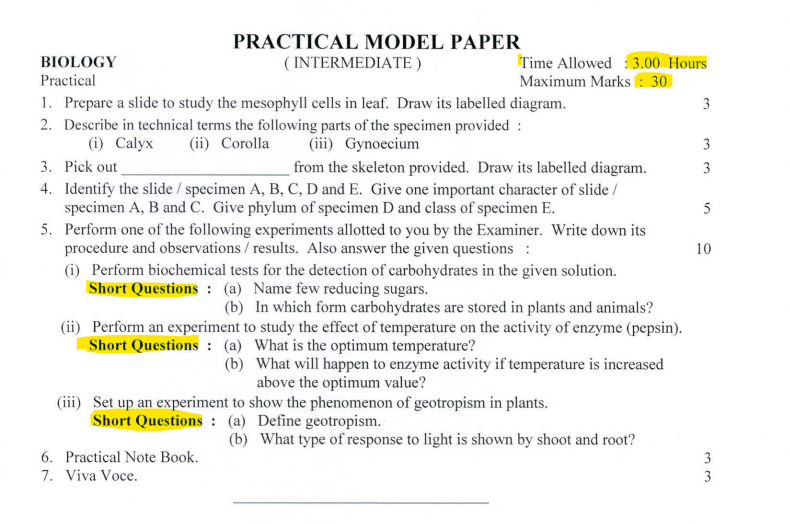
Section 1: Biology Practical Paper Overview
This paper is designed to test your core laboratory skills, technical vocabulary, and understanding of biological mechanisms rather than rote memorization.
| Attribute | Details |
| Subject | Biology (Practical) |
| Level | Intermediate (Class 11 & 12) |
| Time Allowed | 3:00 Hours |
| Maximum Marks | 30 Marks |
Section 2: Question-by-Question Breakdown & Expert Guest Content
Question 1: Slide Preparation & Microscopic Study (3 Marks)
- Task: Prepare a temporary mount slide to study a specific cell type, view it under a microscope, and draw a neatly labeled diagram.
- Standard Example: Study of Mesophyll Cells in a leaf.
💡 Expert Teacher Tip: Examiners look closely at your section cutting technique. Keep your leaf section as thin as possible. Thick sections block light, making mesophyll layers look like a dark blur under the lens. Always label the Palisade and Spongy mesophyll distinctly.
🔥 Most Important Topics for Q1 (Guest Paper):
- Preparation of Onion epidermal cell slide to observe cell wall and nucleus.
- Slide preparation of Amoeba or Paramecium from stagnant water culture.
- Transverse section (T.S.) of a monocot or dicot stem to show vascular bundles.
Question 2: Technical Description of Floral Parts (3 Marks)
- Task: Examine a given live flower specimen and describe its reproductive and non-reproductive parts using precise taxonomic terminology.
📝 Essential Technical Vocabulary Checklist:
- Calyx (Sepals): State if they are Polysepalous (free) or Gamosepalous (fused).
- Corolla (Petals): State if they are Polypetalous (free) or Gamopetalous (fused). Note the shape (tubular, funnel-shaped).
- Gynoecium (Carpels): State the number of carpels, whether they are Apocarpous (free) or Syncarpous (fused), and position of the ovary (Superior/Inferior).
🔥 Most Important Flower Specimens for Lahore Board:
- Solanum nigrum (Mako): Belongs to Solanaceae. Very high chance of appearing.
- Cassia fistula (Amaltas): Belongs to Caesalpiniaceae. Pay attention to its irregular corolla.
- Brassica campestris (Mustard Flower): Crucial for practicing tetradynamous stamens (4 long, 2 short).
Question 3: Skeletal System & Joint Identification (3 Marks)
- Task: Correctly identify a bone or a specific skeletal structure from the physical skeleton provided on the table, and draw its labeled structural diagram.
🔥 Top Important Skeletal Parts to Memorize:
- Pectoral Girdle and Forelimb Bones: Identify Scapula, Clavicle, Humerus, Radius, and Ulna.
- Pelvic Girdle and Hindlimb Bones: Differentiate between Femur, Tibia, and Fibula.
- Vertebrae Types: Learn the structural differences between Atlas, Axis, and Lumbar vertebrae.
Question 4: Slide & Specimen Identification — Spotting (5 Marks)
- Task: You will move between stations (A to E). You get roughly 1 to 2 minutes per station to observe a slide or preserved specimen and write its specific taxonomic rank or feature.
📌 Expected Exam Layout & High-Yield Characteristics:
| Station | Required Info | High-Yield Exam Specimens | Key Identifying Feature to Write |
| A | Differentiating Feature | Hydra | Presence of tentacles and nematocysts. |
| B | Differentiating Feature | Liverwort (Marchantia) | Thalloid structure with gemma cups. |
| C | Differentiating Feature | Tapeworm (Taenia solium) | Ribbon-like segmented body (proglottids) with scolex. |
| D | Identify Phylum | Earthworm or Cockroach | Phylum Annelida (segmented) / Phylum Arthropoda (jointed appendages). |
| E | Identify Class | Frog or Pigeon | Class Amphibia (moist skin, no scales) / Class Aves (feathers, modified forelimbs). |
Question 5: Major Practical Experiments (10 Marks)
This is the highest-weight section. You must perform one experiment assigned by the examiner, document your process methodically, and answer the specific analytical short questions.
Experiment (i): Biochemical Tests for Macromolecules
- Core Task: Detect the presence of reducing or non-reducing carbohydrates, proteins, or lipids in an unknown solution.
High-Yield Short Questions & Expert Answers:
- Q: Name a few reducing sugars.
- Answer: Glucose, Fructose, and Maltose.
- Q: In which form are carbohydrates stored in plants and animals?
- Answer: Stored as Starch in plants and as Glycogen in liver and muscle cells of animals.
- Q: What is the indicator for starch?
- Answer: Iodine solution (turns dark blue/black in the presence of starch).
Experiment (ii): Effect of Temperature on Enzyme Activity
- Core Task: Set up tubes with pepsin or amylase to observe how changing heat zones alter substrate breakdown rates.
                    Enzyme Activity Curve

   Optimal Velocity  -->      |
                             / \
                            /   \
                           /     \
                          /       \
     0°C (Inactive)  ____/         \____  60°C+ (Denatured)
                        Temperature
High-Yield Short Questions & Expert Answers:
- Q: What is the optimum temperature for human enzymes?
- Answer: Approximately 37°C.
- Q: What happens to enzyme activity if the temperature increases significantly above the optimum value?
- Answer: The enzyme activity drops to zero because high thermal energy disrupts hydrogen bonds, denaturing the 3D tertiary shape of the enzyme’s active site permanently.
Experiment (iii): Plant Tropisms (Geotropism / Phototropism)
- Core Task: Demonstrate how plant organs respond to directional environmental stimuli using a clinostat or static germinating seeds.
High-Yield Short Questions & Expert Answers:
- Q: Define geotropism.
- Answer: The directional growth movement of a plant part in response to the gravitational pull of the Earth.
- Q: What type of directional response to gravity and light is shown by shoots and roots?
- Answer:
- Shoots: Show Negative Geotropism (grow away from gravity) and Positive Phototropism (grow toward light).
- Roots: Show Positive Geotropism (grow toward gravity) and Negative Phototropism (grow away from light).
Section 3: Securing the Non-Writing Marks (6 Marks)
Practical Notebook (3 Marks)
Do not take this for granted. Examiners glance at your notebook to verify consistency.
- Ensure every diagram is drawn with a sharp pencil (never ink).
- Make sure your school/college biology teacher has signed and dated the index and individual pages. Unsigned books risk losing all 3 marks instantly.
Viva Voce Oral Examination (3 Marks)
Also Read About: Computer (Practical) Model Papers Lahore Board
The viva examiner wants to see if you actually performed these labs yourself or simply copied them.
🎙️ Top 5 Most Common Viva Questions Asked by Lahore Board Examiners:
- What is the difference between a total mount and a section cut slide?(Answer: A total mount is the whole organism or structure intact, while a section cut is an extremely thin slice designed to see internal cellular layers.)
- Why do we use Benedict’s solution?(Answer: To test for the presence of reducing sugars like glucose; it changes color from blue to green, yellow, or brick-red based on concentration.)
- What is the function of the diaphragm on a compound light microscope?(Answer: It regulates the amount of light passing upward through the condenser to adjust contrast.)
- Name the tissue responsible for transporting water during your plant physiology experiments.(Answer: Xylem tissue.)
- What is an incomplete flower?(Answer: A flower that lacks one or more of the four primary floral whorls: calyx, corolla, androecium, or gynoecium.)
Download In PDF
Final Words for Students
Mastering your Lahore Board Biology practical exam requires precision over long descriptions. Use this comprehensive layout as your definitive revision checklist before stepping into the laboratory hall. Focus on practicing your freehand biological drawings, mastering floral formulas, and understanding the core chemistry behind your food testing reagents. Good luck!