
Chemistry practical exams can feel incredibly stressful for Intermediate students. Success in the laboratory depends heavily on your speed during systematic salt analysis, accuracy in volumetric titrations, and crisp delivery during oral viva evaluations.
To ensure you secure a perfect score, this expert-curated guide breaks down the official BISE Lahore Board Chemistry Practical paper pattern, provides real structural equations, tracks specific laboratory calculations, and shares insider examiner insights.
Section 1: Chemistry Practical Exam Overview
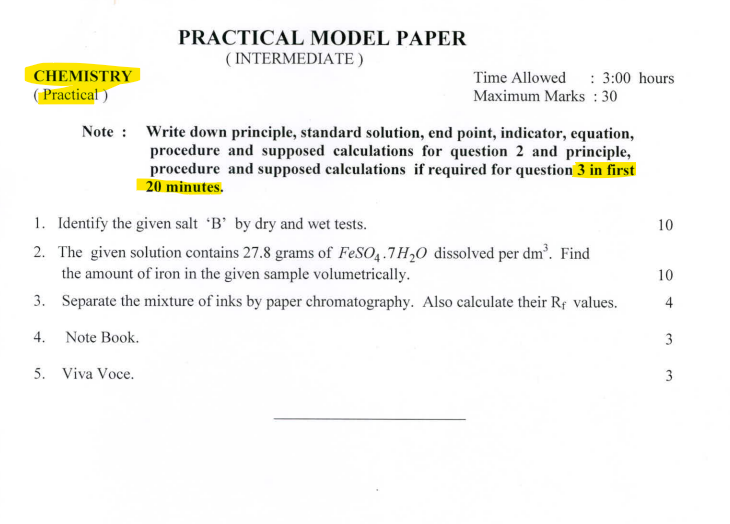
The Lahore Board Intermediate Chemistry practical exam is a 3-hour test carrying a total of 30 marks.
| Attribute | Details |
| Subject | Chemistry (Practical) |
| Level | Intermediate (Class 11 & 12) |
| Time Allowed | 3:00 Hours |
| Maximum Marks | 30 Marks |
⏱️ The 20-Minute Writing Rule: During the first 20 minutes of the exam, you must write down the Principle, Procedure, and Supposed Calculations for Questions 2 and 3 on your answer sheet. The examiner collects or checks this initial work before you begin hands-on lab execution.
Section 2: Complete Paper Layout & High-Yield Expert Content
Question 1: Systematic Salt Analysis (10 Marks)
- Task: Perform a series of dry and wet tests on an unknown inorganic salt mixture to identify its constituent Acid Radical (Anion) and Basic Radical (Cation).
🔥 High-Yield Anion and Cation Combos (Guest List):
- Ammonium Chloride ($\text{NH}_4\text{Cl}$): Look out for the intense pungent smell of ammonia gas upon heating with $\text{NaOH}$.
- Copper Sulfate ($\text{CuSO}_4$): Identified by its distinct blue crystalline appearance and deep blue solution formation when treated with excess Ammonium Hydroxide ($\text{NH}_4\text{OH}$).
- Barium Carbonate ($\text{BaCO}_3$): Rapid effervescence with dilute $\text{HCl}$ indicates $\text{CO}_3^{2-}$, while a heavy white precipitate with $\text{K}_2\text{CrO}_4$ confirms $\text{Ba}^{2+}$.
                 Systematic Salt Analysis Flow

                 [ Dry Tests ]  -->  Flame test / Heating response
                       |
                 [ Wet Tests ]  -->  Original Solution (O.S.) preparation
                       |
               [ Confirmatory ] -->  Distinct precipitate color formation
Question 2: Volumetric Analysis — Redox Titration (10 Marks)
- Task: Determine the concentration, molarity, or total mass of an unknown species using a standard solution via burette titration.
- Standard Exam Problem: The given solution contains 27.8g of $\text{FeSO}_4\cdot7\text{H}_2\text{O}$ per $\text{dm}^3$. Find the total percentage amount of iron in the given sample using standard $\text{KMnO}_4$.
📝 Mandatory Written Protocol Checklist:
- Principle: This is a redox titration. The purple Potassium Permanganate ($\text{KMnO}_4$) acts as a powerful oxidizing agent that converts Ferrous ions ($\text{Fe}^{2+}$) into Ferric ions ($\text{Fe}^{3+}$) under acidic conditions.
- Balanced Equation:$$2\text{KMnO}_4 + 10\text{FeSO}_4 + 8\text{H}_2\text{SO}_4 \rightarrow \text{K}_2\text{SO}_4 + 2\text{MnSO}_4 + 5\text{Fe}_2(\text{SO}_4)_3 + 8\text{H}_2\text{O}$$
- Indicator: No external indicator is needed. $\text{KMnO}_4$ acts as a self-indicator.
- End Point: The appearance of a permanent, light light-pink color that stays for 30 seconds.
📐 Supposed Calculation Structure:
Use the classic volumetric balancing formula to evaluate your molarity:
$$\frac{M_1 V_1}{n_1} (\text{KMnO}_4) = \frac{M_2 V_2}{n_2} (\text{FeSO}_4)$$
Where $n_1 = 2$ and $n_2 = 10$. Always ensure your final strength answer is clearly followed by its appropriate metric unit, such as $\text{g/dm}^3$ or $\text{mol/dm}^3$, to prevent accidental mark deductions.
Question 3: Paper Chromatography (4 Marks)
- Task: Separate a mixture of organic chemical dyes or ink components on a specialized chromatographic strip and calculate individual Retention Factors ($R_f$).
$$\text{Retention Factor } (R_f) = \frac{\text{Distance traveled by the substance spot (cm)}}{\text{Distance traveled by the solvent front (cm)}}$$
⚠️ Common Laboratory Mistake: Never let the baseline pencil mark submerge into the mobile phase solvent reservoir. If the ink spots touch the solvent directly, they will dissolve completely into the pool rather than ascending upward through capillary action.
Section 3: Non-Writing Marks (6 Marks)
Practical Notebook (3 Marks)
- Ensure every diagram is cleanly labeled with a sharp pencil.
- The Absolute Rule: The index sheet must be officially signed and dated by your college chemistry lecturer. Unsigned manuals risk a complete loss of these marks.
Viva Voce Oral Questions (3 Marks)
The oral interviewer checks if you truly understand the core laboratory chemistry or if you simply memorized the steps.
Downloads Model Papers Inter Practical
🎙️ Top 5 Most Common Chemistry Viva Questions:
- Q: Why is dilute sulfuric acid ($\text{H}_2\text{SO}_4$) added during a $\text{KMnO}_4$ titration?
- Answer: To provide the necessary acidic medium ($H^+$ ions) for the reaction and to prevent the premature precipitation of $\text{KMnO}_4$ into manganese dioxide ($\text{MnO}_2$).
- Q: What is the difference between a dry test and a wet test?
- Answer: Dry tests are performed directly on the solid powder salt (like a flame test), whereas wet tests require making an Original Solution (O.S.) by dissolving the salt in a suitable solvent like water or dilute acid.
- Q: Why does $R_f$ value never have any units?
- Answer: Because it is a direct ratio between two identical measurements of distance ($\text{cm}/\text{cm}$), causing the units to cancel out entirely.
- Q: Can the $R_f$ value of a chemical substance ever be greater than 1.0?
- Answer: No. A component spot can never travel further than the maximum moving boundary of the mobile solvent front itself.
- Q: What is a standard solution?
- Answer: A highly stable laboratory solution whose exact concentration and molarity are precisely known.
Also Read About: Biology Practical Model Papers Lahore Board (Intermediate)
Final Words for Students
Securing full marks in your BISE Lahore Chemistry practical exam comes down to keeping your presentation clean and matching your mathematical calculations to your raw data. Use this guide as a direct structural checklist during your revision sessions. Focus on mastering the color transitions of critical assays, tracking your chemical formulas, and setting up clean titrations. Good luck!