
Preparing for the Intermediate Part-I annual examinations under the Board of Intermediate and Secondary Education (BISE) Lahore can be an overwhelming task. FSc Pre-Medical students are faced with a massive Biology syllabus consisting of diverse, detail-heavy chapters ranging from microscopic cellular mechanics to complex ecological frameworks.
The key to scoring a perfect or near-perfect grade in this subject does not lie in blind memorization. Instead, it requires tactical planning. By utilizing the official 1st Year Biology Pairing Scheme 2026, as mapped out in the authentic board blueprint from image, you can significantly optimize your study schedule.
Below, we provide a complete section-by-section breakdown of the paper pattern, highlight major shift warnings, and reveal our exclusive “Smart Combo” blueprint to help you prepare fewer chapters while securing maximum marks.
🧬 Analytical & Conceptual Warnings
A critical evaluation of the official 2026 assessment parameters highlighted in image shows that Punjab Boards are continuing to move away from old-school rote learning (ratta system).
- Conceptual MCQs: Roughly 3 to 4 objective questions will be formulated as “Analytical + Additional” types rather than direct textbook lines.
- Open-Book Style Shorts: Each subjective sub-section will now explicitly incorporate 1 to 2 short questions that test your application of knowledge or feature an open-book conceptual style.
To score high, you must understand the why behind biological processes, such as enzymatic actions or metabolic pathways, rather than just copying standard definitions.
📊 Section-Wise Paper Breakdown (Total Marks: 85)
1. Multiple Choice Questions (MCQs) — 17 Marks
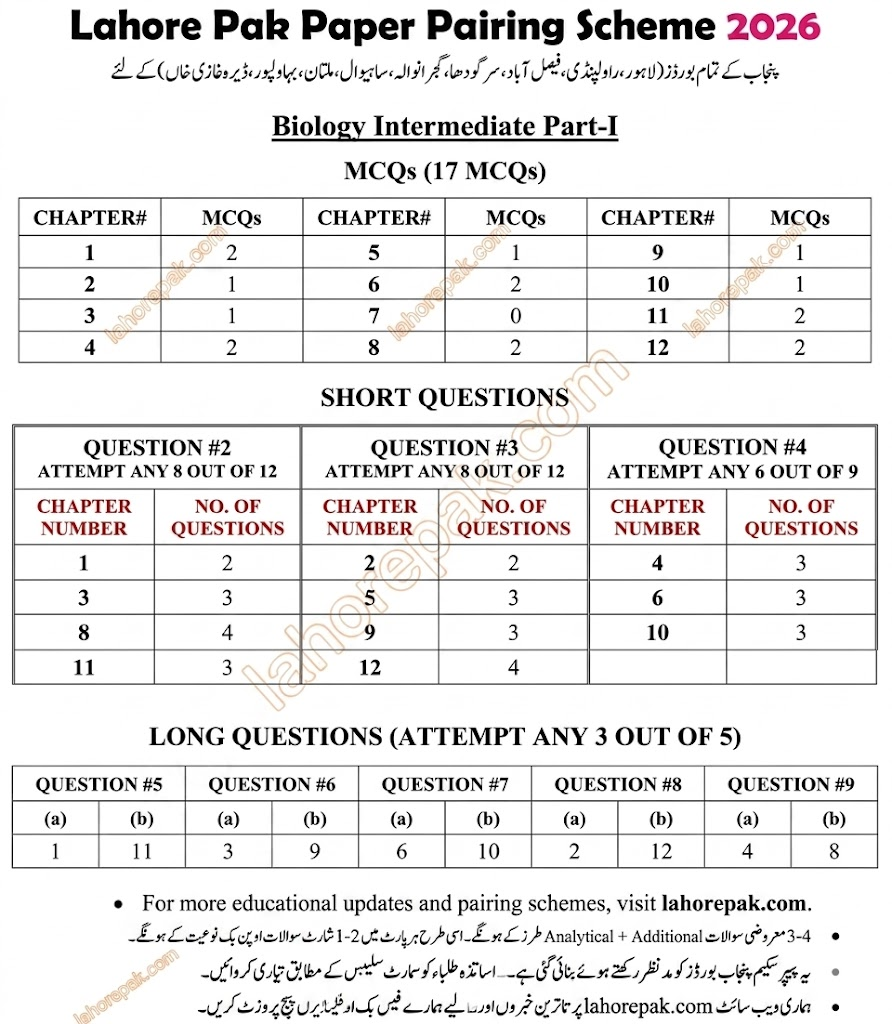
Candidates are given exactly 20 minutes to solve 17 objective questions. According to the blueprint in image, the chapter-wise distribution is highly strategic:
| Chapter Category | Chapter Numbers | MCQs per Chapter |
| High Weightage | Chapters 1, 4, 6, 8, 11, 12 | 2 MCQs each |
| Standard Weightage | Chapters 2, 3, 5, 9, 10 | 1 MCQ each |
| Zero Weightage | Chapter 7 | 0 MCQs |
Takeaway Tip: Notice that Chapter 7 has 0 MCQs allocated in the objective portion, meaning you can safely skip memorizing minutiae or trivial lines from this chapter for the objective section!
2. Short Questions — 44 Marks
The subjective portion is heavily reliant on short questions, divided into three mandatory blocks where students are given a choice to omit certain questions.
- Question #2 (Attempt Any 8 out of 12): Focuses heavily on foundational cellular biology and kingdom diversities.
- Chapter 1: 2 Questions
- Chapter 3: 3 Questions
- Chapter 8: 4 Questions
- Chapter 11: 3 Questions
- Question #3 (Attempt Any 8 out of 12): Heavily balanced around bio-molecules, cell structure, and advanced plant/animal life.
- Chapter 2: 2 Questions
- Chapter 5: 3 Questions
- Chapter 9: 3 Questions
- Chapter 12: 4 Questions
- Question #4 (Attempt Any 6 out of 9): A shorter, compact block focusing on specific prokaryotic, kingdom, and diversity topics.
- Chapter 4: 3 Questions
- Chapter 6: 3 Questions
- Chapter 10: 3 Questions
Also Read About: 1st year chemistry pairing scheme 2026
3. Long Questions — 24 Marks (Attempt Any 3 out of 5)
The long question section is where the pairing scheme truly works to your advantage. You only need to successfully solve 3 complete pairs out of the 5 combinations designated in image. Each question is divided into a part (a) and a part (b):
- Question #5: Part (a) from Chapter 1 | Part (b) from Chapter 11
- Question #6: Part (a) from Chapter 3 | Part (b) from Chapter 9
- Question #7: Part (a) from Chapter 6 | Part (b) from Chapter 10
- Question #8: Part (a) from Chapter 2 | Part (b) from Chapter 12
- Question #9: Part (a) from Chapter 4 | Part (b) from Chapter 8
💡 The “Smart Combo” Strategy: Study Less, Score More
Instead of risking burnout by trying to master the long-form theory of all 14 chapters, a top-tier student will pick their Top 3 combinations and perfect them. Based on text complexity, structural clarity, and predictable markings, here are our recommended combinations:
🏆 Choice Combination 1: Question #5 (Chapters 1 & 11)
- Why it works: Chapter 1 is introductory and highly straightforward. While Chapter 11 (Bioenergetics) is famously complex due to photosynthesis and respiration cycles, mastering its main structural diagrams guarantees full marks.
🏆 Choice Combination 2: Question #8 (Chapters 2 & 12)
- Why it works: Chapter 2 (Biological Molecules) features repetitive, easily memorized chemical structures (carbohydrates, proteins, lipids). Chapter 12 (Nutrition) is highly linear, dealing with digestion steps that are intuitive to study.
🏆 Choice Combination 3: Question #9 (Chapters 4 & 8) or Question #6 (Chapters 3 & 9)
- Choose Question #9 if you prefer cellular anatomy (Chapter 4) and fungi dynamics (Chapter 8).
- Choose Question #6 if you excel at enzyme kinetics (Chapter 3) and plant kingdom classifications (Chapter 9).
The Structural Advantage: By mastering your chosen 3 pairings, you can completely ignore long-theory preparation for the remaining chapters! This frees up massive chunks of revision time to dedicate to your entry-test preparation or other science subjects.
📝 Final Exam Presentation Checklist
- Label Your Diagrams Clearly: In Biology, a long answer without a clear diagram will cause you to drop 1 to 2 marks immediately. Use a sharp lead pencil for sketching and a blue marker for bold labeling.
- Use Bullet Points: Avoid dense paragraphs. Examiners checking thousands of BISE Lahore papers prefer scannable, cleanly structured bullet points that outline characteristics, functions, or phases cleanly.
- Stick to the Layout: Always double-check your question sub-parts. Ensure that if you choose Question #5, you are writing parts (a) and (b) together rather than mixing a part from another question number.