
Preparing for the Intermediate Part-I Annual Exams under the Board of Intermediate and Secondary Education (BISE) Lahore can feel overwhelming. Chemistry is often considered one of the toughest subjects due to its intricate balance of complex numerical problems, abstract orbital theories, and vast organic concepts.
However, smart students do not just study hard—they study smart. By aligning your revision with the official 1st Year Chemistry Pairing Scheme 2026, you can map out exactly which chapters deserve your maximum energy and which ones can be selectively prepared.
In this comprehensive guide, we break down the complete paper pattern, provide a calculated analysis of the 2026 pairing scheme, and share our exclusive “Smart-Pairing Combo” strategy to help you secure a perfect score with reduced stress.
🔬 Expert Analysis on the 2026 Shifts
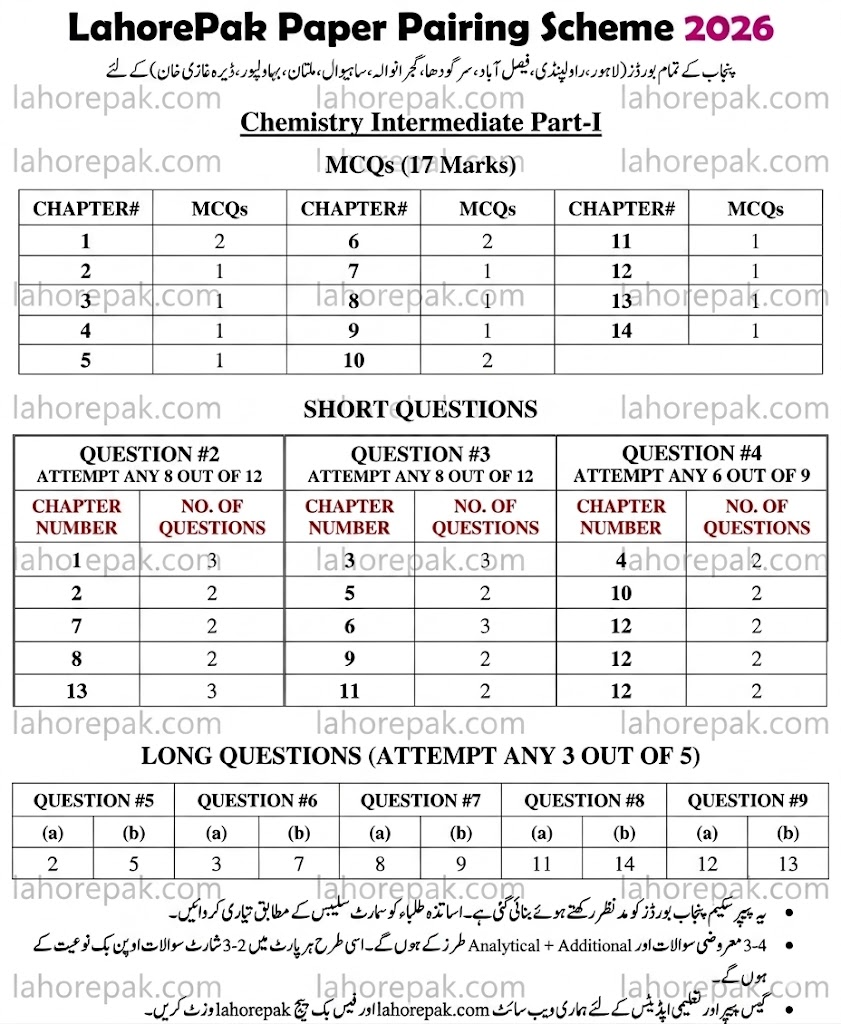
Over the last few seasons, the Punjab Boards have progressively pivoted away from rote-memorization (ratta system) toward conceptual clarity. According to the structural guidelines provided in image_2af9fd.jpg:
- Analytical & Additional Questions: Around 3 to 4 MCQs will be structurally conceptual or additional. Similarly, every short question section contains 1 to 2 questions designed under an analytical or open-book style.
- Numerical Mastery: Theoretical knowledge alone will not save your grades. Chapters like Chapter 1 (Stoichiometry), Chapter 7 (Thermochemistry), and Chapter 8 (Chemical Equilibrium) are historically bound to feature numerical-heavy problems in the long questions section.
📊 Section-Wise Paper Breakdown (Total Marks: 85)
1. Multiple Choice Questions (MCQs) — 17 Marks
You are given 20 minutes to solve 17 objective questions. Every single mark matters here. Based on here is the exact chapter distribution:
| High-Weightage Chapters (2 MCQs Each) | Standard-Weightage Chapters (1 MCQ Each) |
| Chapter 1, Chapter 6, Chapter 10 | Chapters 2, 3, 4, 5, 7, 8, 9, 11, 12, 13, 14 |
2. Short Questions — 44 Marks
The subjective portion begins with short questions, split into three mandatory blocks. You must write precise, structured answers with balanced chemical equations where applicable.
- Question #2 (Attempt Any 8 out of 12): Focuses heavily on foundational physical and physical-chemical chemistry.
- Chapter 1: 3 Questions
- Chapter 2: 2 Questions
- Chapter 7: 2 Questions
- Chapter 8: 2 Questions
- Chapter 13: 3 Questions
- Question #3 (Attempt Any 8 out of 12): Dominates the states of matter and core atomic concepts.
- Chapter 3: 3 Questions
- Chapter 5: 2 Questions
- Chapter 6: 3 Questions
- Chapter 9: 2 Questions
- Chapter 11: 2 Questions
- Question #4 (Attempt Any 6 out of 9): A compact section mixing chemical kinetics and electrochemistry.
- Chapter 4: 2 Questions
- Chapter 10: 3 Questions
- Chapter 12: 4 Questions (Combined sub-parts listed as 2+2)
3. Long Questions — 24 Marks (Attempt Any 3 out of 5)
This is where the pairing scheme saves you massive amounts of time. You only need to pick 3 complete pairs out of the 5 combinations provided. Each question consists of a part (a) and a part (b).
- Question #5: Chapter 2 + Chapter 5
- Question #6: Chapter 3 + Chapter 7
- Question #7: Chapter 8 + Chapter 9
- Question #8: Chapter 11 + Chapter 14
- Question #9: Chapter 12 + Chapter 13
Also Read About: 1st Year English Important Applications 2026 Lahore Board
💡 The “Smart-Pairing” Blueprint: How to Skip 4 Chapters completely
To avoid burnout, do not try to master all 5 long question combinations. Instead, select the Top 3 easiest pairs based on your strengths. Here is our recommended blueprint to score maximum marks with minimum effort:
🏆 Choice Pair A: Question #5 (Chapter 2 & Chapter 5)
- Why it’s great: Chapter 2 (Experimental Techniques) is the shortest and easiest chapter in the entire textbook. Pair it with Chapter 5 (Atomic Structure), which relies on highly structured, predictable topics like Bohr’s Model, Quantum Numbers, and X-rays.
🏆 Choice Pair B: Question #6 (Chapter 3 & Chapter 7)
- Why it’s great: Chapter 3 (Gases) features straightforward laws (Boyle’s, Charles’s, Ideal Gas equation) that are easy to visualize. Chapter 7 (Thermochemistry) is remarkably brief and revolves around basic concepts like Born-Haber Cycle and Hess’s Law.
🏆 Choice Pair C: Question #7 (Chapter 8 & Chapter 9) or Question #9 (Chapter 12 & Chapter 13)
- If you are great at calculations, pick Question #7 (Le-Chatelier’s principle and basic solution definitions).
- If you prefer technical applications, pick Question #9 (Electrochemistry and basic functional groups/macromolecules).
The Secret Benefit: By perfecting your chosen 3 pairs, you can completely leave the long-form theory/numericals of the remaining 4 chapters on option! This allows you to hyper-focus on your selected chapters to achieve flawless presentation.
📝 Strategic Tips from a Teacher’s Desk
- Equations are Mandatory: In Chemistry, a text description without a balanced chemical equation or a formula will immediately lose 50% of its marks. Always highlight reactions using a black marker.
- Never Skimp on Units: When solving numerical data from Chapter 1 or Chapter 7, ensure your final answer explicitly displays the unit (e.g., $mol$, $dm^3$, $kJ/mol$).
- Handle Part-B First: In long questions, if part (a) is a theory and part (b) is a numerical problem, always outline your numerical data clearly. Numericals are highly objective; if your method and answer are correct, you get a solid 4/4 without any examiner deductions.