
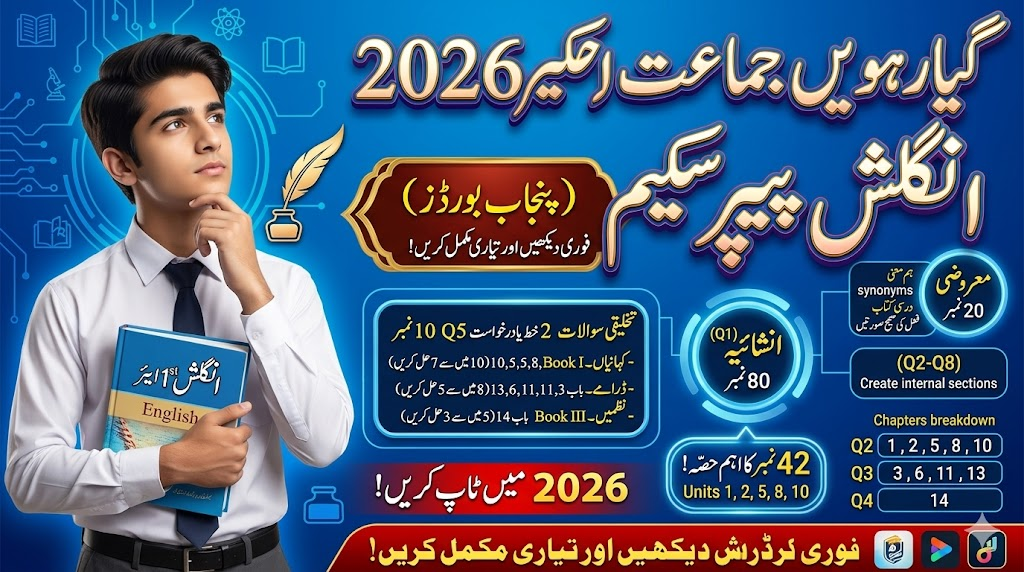
Navigating the Intermediate Part-I examination requires strategic planning, especially for a compulsory language paper like English. To assist students in achieving optimal scores, the official paper pairing scheme for the academic year 2026 outlines the precise distribution of marks across objective and subjective portions. This definitive blueprint helps students align their revision schedules with the exact patterns adopted by the paper setters of the Board of Intermediate and Secondary Education (BISE) Lahore and other Punjab boards.
The total weightage of the 11th Class English paper is 100 Marks, split neatly into a 20-mark Objective Part (MCQs) and an 80-mark Subjective Part. Understanding which units contribute to synonyms, short questions, and translation exercises allows candidates to focus their attention on high-yield sections of the curriculum.
Core Paper Breakdown Matrix
| Section | Component Type | Question Sequence | Total Marks |
| Objective | Multiple Choice Questions (Synonyms, Textual MCQs, Verbs) | Question #1 (A, B, C, D) | 20 Marks |
| Subjective Part I | Short Answer Questions (Book I & Book III) | Questions #2, #3, #4 | 30 Marks |
| Subjective Part II | Letters/Applications, Creative Story Writing | Questions #5 & #6 | 20 Marks |
| Subjective Part III | Stanza Explanation, Punctuation, & Pairs of Words | Question #7 (a, b, c) | 15 Marks |
| Subjective Part IV | Contextual Urdu Translation (or English Essay alternative) | Question #8 | 15 Marks |
1. Objective Part: Question #1 (MCQs) — 20 Marks
The objective component evaluates textual comprehension, vocabulary breadth, and grammatical command. Candidates must answer 20 compulsory multiple-choice questions within the specified time. The precise chapter-wise distribution is detailed below:
- Unit No. 1, 2, 5, 8, and 10 (Book I): 5 Synonyms + 3 Textual MCQs based on the mentioned units. (8 Marks)
- Unit No. 3, 6, 11, and 13 (Book III): 3 Synonyms + 2 Textual MCQs based on the mentioned units. (5 Marks)
- Unit No. 14 (Book III): 2 Synonyms extracted from this specific unit. (2 Marks)
- Grammar & Syntax Rules: 5 MCQs requiring selection of the correct form of the verb (drawn generally from Units 1, 2, 3, 5, 6, 8, 10, 11, 13, 14). (5 Marks)
2. Subjective Part (80 Marks)
The subjective section demands comprehensive writing skills, analytical understanding of literature, and syntactic precision. It is segmented into distinct analytical, functional, and creative blocks.
Part I: Short Answer Questions — 30 Marks
This segment assesses specific comprehension of text materials spanning Book I (Short Stories) and Book III (Plays & Poetry).
- Question #2 (Book I – Short Stories): Drawn directly from Unit No. 1, 2, 5, 8, and 10. Students are presented with 10 short questions and must successfully attempt any 7. (Marks: 7 × 2 = 14)
- Question #3 (Book III – Plays): Evaluates thematic elements from Unit No. 3, 6, 11, and 13. Contains 8 short questions where students must attempt any 5. (Marks: 5 × 2 = 10)
- Question #4 (Book III – Poetry): Focusing closely on Unit No. 14. Comprises 5 targeted short questions; students must attempt any 3. (Marks: 3 × 2 = 6)
Part II: Functional & Creative Composition — 50 Marks
This core block tests advanced structural writing, language rules, applied translation, and textual analysis:
- Question #5 (Letter OR Application Writing): Students are given an explicit internal choice between drafting a formal business/official Letter or a formal Job/Leave Application. (10 Marks)
- Question #6 (Moral Story Writing): Requires writing an expansive narrative based on moral themes. Students select ANY ONE outline from 2 provided moral topics. (10 Marks)
- Question #7 (Applied Language & Applied Text Mechanics): This multi-tiered question is divided into three distinct sub-components:
- Explanation of Stanza: Read a given stanza from the prescribed poems and write an explanation with reference to the context. (5 Marks)
- Punctuation: Correct the punctuation marks within a small unpunctuated paragraph selected specifically from Unit No. 1, 2, 5, 8, and 10. (5 Marks)
- Pairs of Words: Incorporate exactly 5 out of 8 provided pairs of homophones/confusable words into distinct sentences showing their meanings clearly. (5 Marks)
- Question #8 (Translation Practice): Requires the translation of a continuous English prose paragraph into fluent, grammatically sound Urdu. This paragraph is selected exclusively from Unit No. 1, 2, 5, 8, and 10 of English-11. (15 Marks)
Important Regulation for Alternative Candidates: English-medium or foreign candidates who are not evaluated on Urdu translation standard modules are explicitly permitted to compose an extensive analytical Essay on a given topic instead of executing the translation block in Question #8.
Download In PDF
Strategic Recommendations for High-Scorers
An examination of the 2026 pairing scheme highlights a massive concentration of marks within a few specific units. Unit No. 1, 2, 5, 8, and 10 are critical focal points. Together, they dictate 8 marks in MCQs, 14 marks in short questions, 5 marks in punctuation, and 15 marks in translation. Mastering these five specific chapters securely safeguards a foundational 42 marks out of the entire paper.
Also Read More About: 1st Year Pairing Scheme 2026 Lahore Boards
Additionally, practicing time management across subjective compositions ensures that extensive portions like stories, letters, and context explanations receive adequate detail without leaving questions incomplete near the closing bell.