
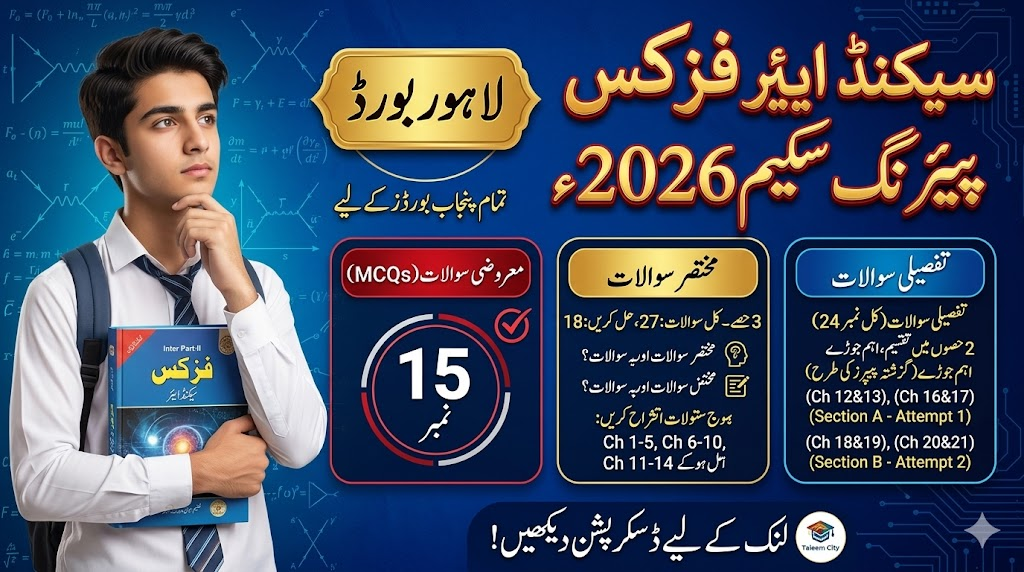
Preparing for the Intermediate Part-II annual examinations requires a strategic approach, especially for a conceptual subject like Physics. To score high marks, students need to understand exactly how the board structures the final paper. The 2nd Year Physics Pairing Scheme 2026 for the Lahore Board acts as an official blueprint, allowing students to focus their energy on high-yield chapters and plan their selective study efficiently.
This article provides a comprehensive, chapter-wise breakdown of the total marks distribution—including Multiple Choice Questions (MCQs), Short Questions, and Long Questions.
2nd Year Physics Total Marks Distribution
The total marks for the 2nd-year Physics theory paper are 85, while the remaining 30 marks are allocated to practical examinations. The theory paper is divided into two primary sections:
- Objective Portion (MCQs): 17 Marks (Time allowed: 20 minutes)
- Subjective Portion (Short & Long Questions): 68 Marks (Time allowed: 2 hours and 40 minutes)
Objective Section: MCQs Breakdown (17 Marks)
The objective paper contains 17 compulsory multiple-choice questions. Earning full marks in this section requires thorough reading of textbook lines and exercise objectives. The chapter-wise distribution is detailed below:
| Chapter Number | Number of MCQs |
| Chapter 12 (Electrostatics) | 2 MCQs |
| Chapter 13 (Current Electricity) | 1 MCQ |
| Chapter 14 (Electromagnetism) | 2 MCQs |
| Chapter 15 (Electromagnetic Induction) | 2 MCQs |
| Chapter 16 (Alternating Current) | 2 MCQs |
| Chapter 17 (Physics of Solids) | 1 MCQ |
| Chapter 18 (Electronics) | 2 MCQs |
| Chapter 19 (Dawn of Modern Physics) | 2 MCQs |
| Chapter 20 (Atomic Spectra) | 1 MCQ |
| Chapter 21 (Nuclear Physics) | 2 MCQs |
Subjective Section: Short Questions (44 Marks)
The short questions section is split into three distinct questions (Question #2, Question #3, and Question #4). It forms the largest scoring block of the subjective paper.
Question #2 (Attempt Any 8 out of 12)
This block heavily focuses on fundamental electrical, magnetic, and nuclear principles. You must answer any 8 questions:
- Chapter 12: 4 Short Questions
- Chapter 14: 4 Short Questions
- Chapter 21: 4 Short Questions
Question #3 (Attempt Any 8 out of 12)
This portion covers circuitry, solid-state physics, and basic electronics. You must answer any 8 questions:
- Chapter 13: 3 Short Questions
- Chapter 16: 3 Short Questions
- Chapter 17: 3 Short Questions
- Chapter 18: 3 Short Questions
Question #4 (Attempt Any 6 out of 9)
This section targets modern physics and atomic phenomena. You must answer any 6 questions:
- Chapter 15: 3 Short Questions
- Chapter 19: 4 Short Questions
- Chapter 20: 2 Short Questions
Important Note on Question Style: As per the official instructions in
image_d96540.jpg, around 50% of the short questions are taken directly from the textbook exercises, while the remaining 50% are conceptual or open-book style questions testing core principles. Additionally, every short question block will feature 1 to 2 highly conceptual questions.
Subjective Section: Long Questions (24 Marks)
In this section, students are given 5 extensive questions, and they must attempt any 3 out of 5. Each long question is split into two parts: (a) which is typically a theoretical derivation, and (b) which is a numerical problem.
The 2026 pairing combination for theory and numerical parts is structured as follows:
- Question #5: Part (a) or (b) from Chapter 12 & Chapter 13
- Question #6: Part (a) or (b) from Chapter 14 & Chapter 15
- Question #7: Part (a) or (b) from Chapter 16 & Chapter 18
- Question #8: Part (a) or (b) from Chapter 17 & Chapter 19
- Question #9: Part (a) or (b) from Chapter 20 & Chapter 21
Crucial Numerical Alert: According to the official scheme instructions in
image_d96540.jpg, there is no fixed rule stating that part (b) will always be the numerical. A numerical problem can be asked from either of the paired chapters in a question. Students must prepare both the theory and numericals for their chosen chapter pairs.
Also Read More About: Physics Practical Model Papers Lahore Board (Intermediate)
Smart Preparation Tactics for 2026 Exams
- Select 3 Core Pairs: Do not try to master long questions for all 10 chapters. Instead, pick 3 complete pairs (such as Chapters 12 & 13, Chapters 14 & 15, and Chapters 20 & 21) and thoroughly prepare both their theoretical derivations and numerical examples.
- S.L.O and Conceptual Focus: Because 50% of the short questions are conceptual, avoid simple rote memorization. Understand the “why” behind physics formulas, units, and laws.
- High-Yield Chapters for Short Questions: Chapters 12, 14, 19, and 21 carry the highest weightage for short questions. Mastering these specific chapters guarantees a massive safety net in the subjective section.
This pairing scheme represents the expected assessment structure compiled for Punjab Educational Boards (including Lahore, Gujranwala, Rawalpindi, Faisalabad, Multan, Sargodha, Sahiwal, Bahawalpur, and D.G. Khan). While it is highly accurate for the 2026 session, minor variations can occasionally be introduced by the board authorities.