
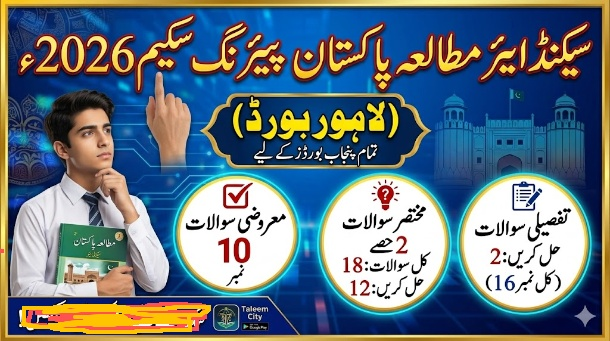
Preparing for the Intermediate Part-II annual exams requires smart work alongside hard work. For a compulsory subject like Pakistan Studies (Mutalia Pakistan), knowing the exact weightage of each chapter allows you to plan your studies strategically. The 2nd Year Pak Studies Pairing Scheme 2026 for Lahore Board gives you a complete roadmap of how the final board paper will be structured.
By utilizing the official assessment pattern details and guide provides a 100% unique breakdown of the marks distribution, helping you secure maximum marks with selective and focused preparation.
2nd Year Pak Studies Total Marks Breakdown
The total marks for the 2nd-year Pakistan Studies theory paper are 50. Unlike elective subjects, the exam duration is shorter, making time management incredibly important. The paper is split into two sections:
- Objective Type (MCQs): 10 Marks
- Subjective Type (Short & Long Questions): 40 Marks
Objective Portion: MCQs Breakdown (10 Marks)
The objective section features 10 compulsory multiple-choice questions, each carrying 1 mark. To secure a perfect 10/10, you must focus on textbook exercises as well as core historical dates and events mentioned within the chapters.
The chapter-wise MCQ distribution for 2026 is as follows:
| Chapter Number | Number of MCQs |
| Chapter 1 | 3 MCQs |
| Chapter 2 | 1 MCQ |
| Chapter 3 | 2 MCQs |
| Chapter 5 | 1 MCQ |
| Chapter 6 | 2 MCQs |
Strategic Note: Keep in mind that according to the board guidelines in
image_d96540.jpg, 1 to 2 MCQs can be analytical or additional (out of exercise). Chapter 1 and Chapter 3 hold the highest importance for the objective portion, accounting for half of the total MCQs.
Subjective Portion: Short Questions (24 Marks)
The short questions section is divided into two main question blocks: Question #2 and Question #3. In each block, students are given 9 questions and must attempt any 6. Each correct answer awards 2 marks, making this section worth 24 marks in total.
Question #2 (Attempt Any 6 out of 9)
This section heavily evaluates the early history of Pakistan, its ideological basis, and initial political developments:
- Chapter 1: 2 Short Questions
- Chapter 2: 4 Short Questions
- Chapter 3: 3 Short Questions
Question #3 (Attempt Any 6 out of 9)
This portion deals with constitutional history, foreign policy, land, resource distribution, and current societal issues:
- Chapter 4: 3 Short Questions
- Chapter 5: 3 Short Questions
- Chapter 6: 2 Short Questions
- General/Current Topics (Dengue / Terrorism): 1 Short Question
Subjective Portion: Long Questions (16 Marks)
The long questions section gives you excellent flexibility. There are 3 extensive questions printed on the paper (Question #4, Question #5, and Question #6). Students are required to attempt any 2 out of 3. Each question carries 8 marks.
Also Read About: Best Degree after intermediate in Lahore
The 2026 pairing combination for long questions is structured around the following chapter pairs:
- Question #4 (8 Marks): Will be selected from Chapter 1 OR Chapter 2.
- Question #5 (8 Marks): Will be selected from Chapter 3 OR Chapter 4.
- Question #6 (8 Marks): Will be selected from Chapter 5 OR Chapter 6.
Smart Study & S.L.O Preparation Strategy for 2026
- Master 4 Selected Chapters for Long Questions: To score full marks in the long question section, you do not need to study the long answers for all 6 chapters. Simply pick two complete pairs that you find easiest (for example, Chapters 1 & 2 and Chapters 3 & 4) and master them completely.
- Be Ready for Conceptual Questions: The Lahore Board examinations are fully S.L.O (Student Learning Outcomes) based. Each short question portion will include 1 to 2 analytical or open-book style questions. Avoid plain rote memorization and focus on understanding historical causes and effects.
- Don’t Ignore the General Awareness Question: In Question #3, one short question is dedicated to general social awareness topics like Dengue prevention or anti-terrorism measures. Keep basic safety facts and national historical contexts in mind for this question.
This pairing scheme represents the expected paper pattern compiled for Punjab Boards (including Sargodha, Sahiwal, Lahore, Gujranwala, Faisalabad, Multan, Rawalpindi, Bahawalpur, and D.G. Khan).