
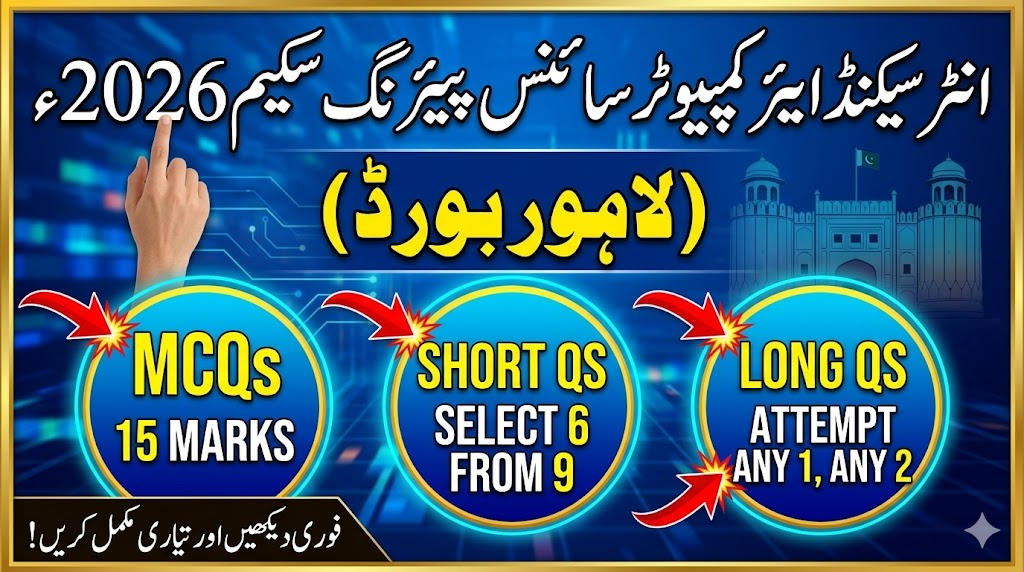
Preparing for the Intermediate Part-II annual examinations can be overwhelming, but understanding the paper pattern makes it significantly easier. The 2nd Year Computer Science Pairing Scheme 2026 for Lahore Board serves as a strategic roadmap for students. By aligning your studies with this expected paper distribution, you can prioritize high-yield chapters, manage your time effectively, and maximize your score.
This comprehensive guide breaks down the complete marks distribution, including Multiple Choice Questions (MCQs), Short Questions, and Long Questions, as detailed in the assessment pattern provided in below.
2nd Year Computer Science Total Marks Breakdown
The total marks for the 2nd-year Computer Science theory paper are 75. The paper is structurally divided into two main parts:
- Objective Type (MCQs): 15 Marks
- Subjective Type (Short & Long Questions): 60 Marks
Objective Paper: MCQs (15 Marks)
The objective section consists of 15 compulsory multiple-choice questions, with 1 mark awarded for each correct answer. The chapter-wise distribution of MCQs for 2026 is as follows:
| Chapter Number | Number of MCQs |
| Chapter 1 | 1 MCQ |
| Chapter 2 | 1 MCQ |
| Chapter 3 | 1 MCQ |
| Chapter 4 | 1 MCQ |
| Chapter 5 | 1 MCQ |
| Chapter 6 | 1 MCQ |
| Chapter 7 | 0 MCQs |
| Chapter 8 | 2 MCQs |
| Chapter 9 | 2 MCQs |
| Chapter 10 | 1 MCQ |
| Chapter 11 | 1 MCQ |
| Chapter 12 | 1 MCQ |
| Chapter 13 | 1 MCQ |
| Chapter 14 | 1 MCQ |
Strategy Tip for MCQs: Pay special attention to Chapter 8 and Chapter 9, as they carry double weightage (2 MCQs each) in this section. Conversely, you can skip looking for textbook exercise MCQs in Chapter 7 since no objective questions are expected from it.
Subjective Paper: Short Questions
The short questions section is divided into three distinct question blocks (Question #2, Question #3, and Question #4). In each block, students are given a choice to attempt any 6 out of 9 questions.
Question #2 (Attempt Any 6 out of 9)
This portion mainly tests foundational data concepts and database administration basics:
- Chapter 1: 3 Short Questions
- Chapter 2: 2 Short Questions
- Chapter 4: 2 Short Questions
- Chapter 5: 2 Short Questions
Question #3 (Attempt Any 6 out of 9)
This section shifts focus toward the programming environment, basic input/output, and file handling:
- Chapter 8: 3 Short Questions
- Chapter 10: 4 Short Questions
- Chapter 14: 2 Short Questions
- Note: No short questions will be asked from Chapters 3, 6, 7, and 9 in this block.
Question #4 (Attempt Any 6 out of 9)
This block heavily targets core programming mechanics such as decision structures, loops, and functions:
- Chapter 11: 3 Short Questions
- Chapter 12: 3 Short Questions
- Chapter 13: 3 Short Questions
Also Read More About: Computer Practical MODEL PAPERS Lahore Board [12th Class]
Subjective Paper: Long Questions
The long questions section provides critical choices that allow you to balance your preparation between the Database (MS Access) portion and the C Language programming portion.
The scheme divides long questions into two choice pools:
Pool 1: Database Section (Attempt Any 1)
Students must choose one long question from the first two options:
- Question #5: Will be selected from Chapter 1 OR Chapter 3.
- Question #6: Will be selected from Chapter 6 OR Chapter 7.
Pool 2: C Language Section (Attempt Any 2)
Students must choose two long questions from the remaining three options:
- Question #7: Selected from Chapter 8 OR Chapter 9 (Focuses purely on Theory).
- Question #8: Selected entirely from Chapter 11.
- Question #9: Selected entirely from Chapter 12.
Smart Study & Exam Preparation Strategy
- S.L.O Based Alert: Keep in mind that examinations follow Student Learning Outcomes (S.L.O) criteria. This means questions may be conceptual rather than copied directly from exercise text. Focus on understanding definitions and code execution logic rather than rote memorization.
- Mastering the C-Language Basics: If programming logic feels challenging, ensure you master Chapter 8 and Chapter 9 theory for Question #7, alongside the short questions in Question #3 to secure safe marks.
- The Conditional & Loop Powerhouse: Focusing deeply on Chapters 11 and 12 prepares you simultaneously for 6 short questions and 2 complete long questions, forming the backbone of your subjective score.
This pairing scheme represents the expected assessment structure compiled for Punjab Boards (including bise Bahawalpur, bise Lahore, Gujranwala, Sahiwal, Sargodha, Rawalpindi, Faisalabad, Multan, and bise D.G. Khan). Minor variations can occasionally occur in official board settings, so thorough coverage of the syllabus is highly recommended.