

For matriculation (SSC Part-II) students under the Board of Intermediate and Secondary Education (BISE) Lahore, the Computer Science practical exam represents a critical component of the final grade. Unlike theory papers, the practical exam demands hands-on execution, logical thinking, and precise presentation on your answer sheet.
Understanding the official BISE Lahore Computer Science practical paper pattern is the single most effective way to secure a perfect score. Below is a comprehensive breakdown of the marks distribution, question formats, and expert tips to ace your lab examination.
BISE Lahore Computer Science Practical Exam Overview
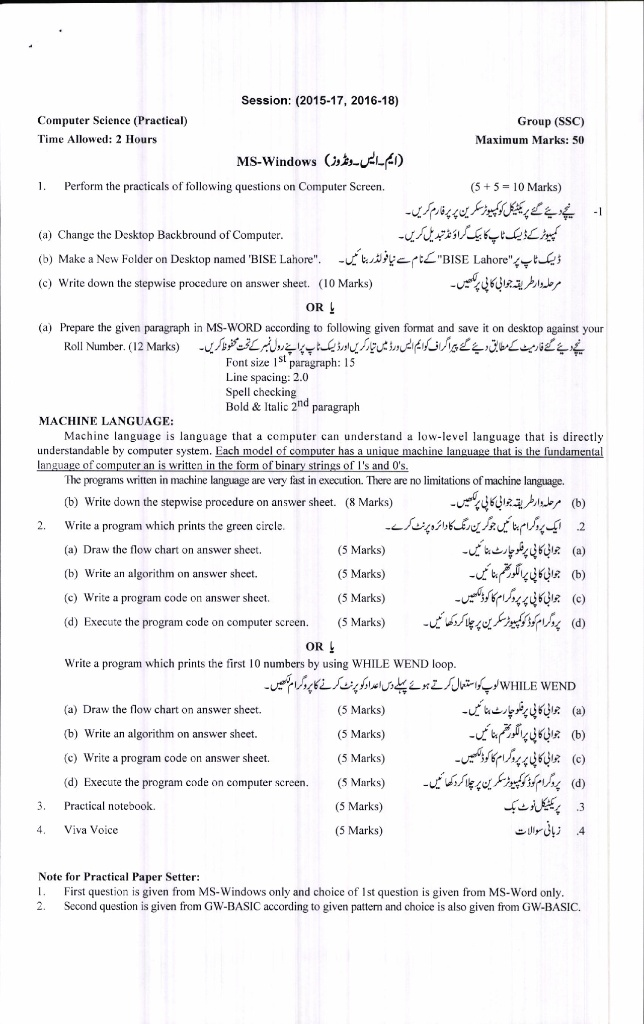
According to the official model paper guidelines, the practical assessment evaluates both operating system familiarity and core programming logic.
- Maximum Marks: 50 Marks
- Time Allowed: 2 Hours
- Target Audience: Matric / SSC Part-II Students (Lahore Board)
Unlike some other science subjects that are worth 30 marks, Computer Science practicals hold a 50-mark weightage, making it an absolute game-changer for your overall percentage.
Section-by-Section Marks Breakdown
The paper is strategically split into OS/Office Automation tasks, basic programming (GW-BASIC), notebook presentation, and oral examination.
1. Section 1: MS-Windows & MS-Word (20 Marks total)
The first portion of the paper tests your foundational IT skills. The paper setter follows a strict rule: the primary question comes from MS-Windows, while the alternative choice comes from MS-Word.
- Option A (MS-Windows):Students are required to perform fundamental tasks directly on the computer screen. Typical tasks include changing the desktop background or creating a specific directory structure (e.g., creating a new folder on the Desktop named
"BISE Lahore").- Execution on Screen: 10 Marks (5 + 5 marks for tasks)
- Written Procedure: 10 Marks (Writing the exact steps down on your answer sheet)
- Option B (MS-Word Alternative):If you choose the MS-Word option, you must format a provided paragraph on screen according to strict typography rules—such as adjusting font sizes, modifying line spacing (e.g., setting it to 2.0), running spell checks, and applying bold or italic styles—before saving the file against your roll number. (Worth 12 Marks for formatting, combined with step documentation).
2. Section 2: GW-BASIC Programming & Logic (20 Marks total)
This section assesses your problem-solving capabilities using programming structures (typically GW-BASIC). The paper provides two distinct programs, and students must choose one to implement fully.
Common programming tasks include drawing basic geometric graphics (like a green circle) or working with control loops (such as printing the first 10 numbers using a WHILE...WEND loop). This 20-mark question is strictly divided into four structural parts:
- (a) Flowchart Development: 5 Marks (Drawing the logical flow diagram on the answer sheet)
- (b) Algorithm Writing: 5 Marks (Writing down the step-by-step plain English solution)
- (c) Code Writing: 5 Marks (Writing the syntax-accurate program code on paper)
- (d) Code Execution: 5 Marks (Compiling and running the program live on the computer monitor)
3. Practical Notebook (5 Marks)
A certified, signed practical notebook containing all the year’s lab tasks must be presented to the external examiner. Keeping it neat and thoroughly completed guarantees these 5 marks.
Also Read More About: Lahore Board 10th Class Chemistry Practical Model Papers & Paper Pattern
4. Viva Voce / Oral Examination (5 Marks)
The examiner conducts a brief interactive session to test your conceptual clarity. Questions usually revolve around fundamental definitions found in the paper itself, such as defining low-level machine languages, binary strings ($1\text{s}$ and $0\text{s}$), loop mechanisms, or basic Windows shortcuts.
Strategic Tips for AdSense-Level Quality & High Marks
To stand out to your examiner and ensure your paper scores perfectly, implement these preparation strategies:
- Write Step-by-Step Procedures: Do not skip steps when writing answers on paper. Use clear headings like Step 1: Right-click on the desktop, Step 2: Select New -> Folder, etc.
- Practice Loop Syntax: Ensure you know how to open and close loops correctly in GW-BASIC (
FOR...NEXTorWHILE...WEND). Missing a closing statement will result in execution errors. - Flowchart Symbols Matter: Never mix up flowchart shapes. Use ovals for Start/Stop, rectangles for Processing, and diamonds for Decision-making steps.
- Prepare Basic Definitions for Viva: Be ready to explain what a compiler, an algorithm, and a binary language mean.
By practicing your on-screen commands alongside written algorithms, you can comfortably secure a flawless 50/50 in your BISE Lahore Computer Science practical exam.