
Securing full marks in the Matric Board Exams requires equal dedication to both theoretical and practical assessments. For 10th-class students under the Board of Intermediate and Secondary Education (BISE) Lahore, the Chemistry practical exam holds a crucial 30 marks.
To help students maximize their scores, analyzing the official model papers and understanding the precise layout of the exam is essential. Below, we break down the latest paper pattern, marking criteria, and important experiments based on the official Lahore Board framework.
BISE Lahore Chemistry Practical Exam Structure
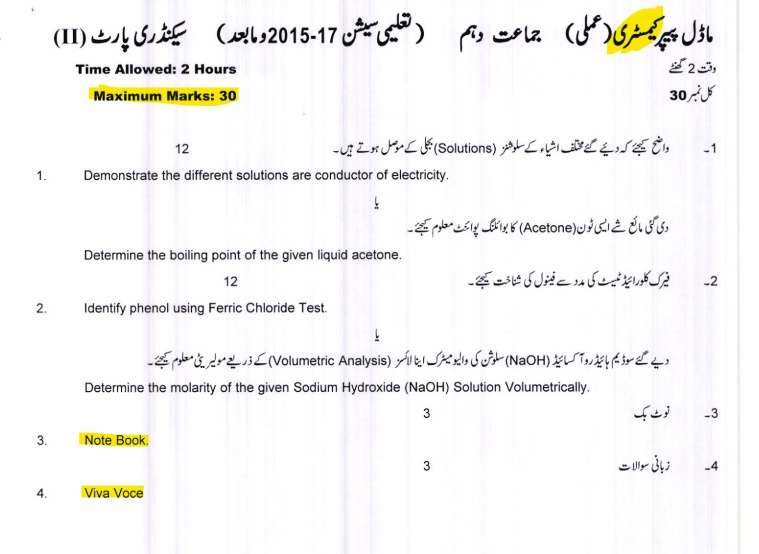
As shown in the official model paper, the practical exam is highly structured, offering limited time but clear choices. Students must manage their time effectively to perform the experiment and write down the observations clearly.
- Total Marks: 30 Marks
- Time Allowed: 2 Hours
- Target Class: Matric / SSC Part-II (Secondary School Certificate)
Detailed Marks Distribution (Paper Pattern Breakdown)
To avoid losing marks unnecessarily, students must understand exactly how the examiner divides the 30 marks. The paper consists of major experiments, notebooks, and oral questions.
1. Major Experiment — Section 1 (12 Marks)
The first part of the paper tests fundamental laboratory techniques, particularly focusing on electrical conductivity and physical properties. Students are usually given a choice between two distinct experiments:
- Option A: Demonstrating whether different provided solutions are conductors of electricity.
- Option B: Determining the precise boiling point of a given organic liquid, such as Acetone.
2. Major Experiment — Section 2 (12 Marks)
The second section focuses heavily on analytical chemistry, qualitative organic analysis, and volumetric analysis (titrations). Students must perform one of the following:
- Option A: Identifying functional groups like Phenol using specialized chemical reactions like the Ferric Chloride Test.
- Option B: Determining the molarity of an unknown Sodium Hydroxide ($\text{NaOH}$) solution via Volumetric Analysis (Titration).
3. Practical Note Book (3 Marks)
A neatly maintained, signed, and complete practical notebook is mandatory. Examiners award 3 marks simply for presenting a clean record of your year-long laboratory work.
4. Viva Voce / Oral Test (3 Marks)
The examiner will ask brief, conceptual questions related to the experiments performed during the session. Having clear baseline concepts ensures a perfect score in this section.
Also Read More About: Biology Practical Model Papers Lahore Board (10th Class)
Key Experiments to Focus On for Highest Marks
Based on historical data and model papers from the Lahore Board, certain experiments appear frequently. Prioritizing these topics during your revision will significantly improve your performance:
Volumetric Analysis (Titrations)
Understanding how to perform an acid-base titration is vital. Practice calculating molarity using the standard formula:
$$M_1 V_1 = M_2 V_2$$
Make sure you know the exact color changes for common indicators like Phenolphthalein and Methyl Orange.
Identification of Organic Compounds
Organic chemistry practicals often revolve around identifying functional groups. Memorize the steps, observations, and inferences for the Ferric Chloride Test used to detect phenolic groups, as well as test methods for carboxylic acids and aldehydes.
Determination of Physical Constants
Be thorough with the experimental setups required to find the melting points of solids (like Naphthalene) and boiling points of volatile liquids (like Acetone or Ethanol). Accurately reading the thermometer is where most students get marked down.
Top Tips to Excel in the 10th Class Chemistry Practical Exam
- Master the Apparatus Diagrams: Draw clean, labeled diagrams of your experimental setups. A well-drawn diagram instantly creates a positive impression on the examiner.
- Write Observations Clearly: Do not just write the final result. Ensure your data tables, initial/final burette readings, and calculations are neatly presented.
- Prepare for Viva Confidently: Review basic definitions such as molarity, standard solution, indicator, functional group, and electrolyte. Most viva questions are pulled directly from these definitions.
- Keep Your Notebook Updated: Ensure all your experiments are verified and signed by your school teacher well before the exam date.
Download In PDF
By understanding this blueprint and practicing the key chemical equations and procedures, achieving a perfect 30/30 on your BISE Lahore Chemistry practical exam is entirely within your reach.