

Preparing for the Matric Secondary School Certificate (SSC Part-II) Biology Practical Examination under the Board of Intermediate and Secondary Education (BISE), Lahore requires a solid understanding of both theoretical concepts and laboratory application. Many students struggle to secure full marks in this section because they misinterpret the question layout, miss specific identification keys, or fail to document their procedures within the allotted timeframe.
BISE Lahore 10th Class Biology Practical Structure & Marks Weightage
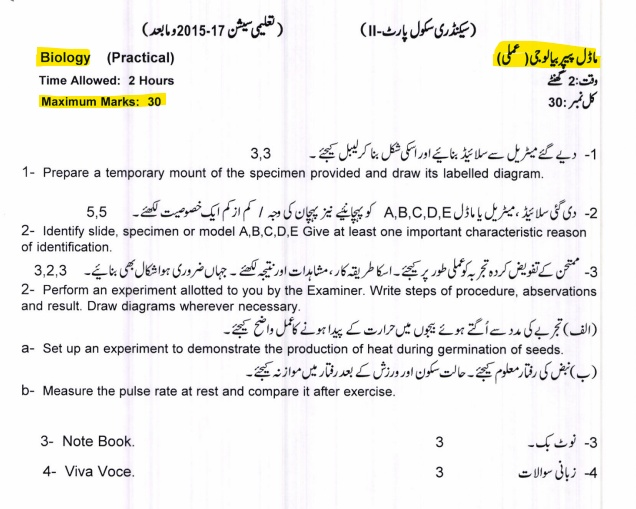
The Biology practical examination is a high-yield assessment worth a maximum of 30 Marks, with an absolute time limitation of 2 Hours. Success relies on dividing your time efficiently between sliding microscope alignments, specimen sifting, and your written experimental methodology.
Practical Evaluation Matrix
| Question Ref | Core Laboratory Module & Tasks | Evaluation Standard | Marks Breakdown | Total Marks |
| Q1 | Temporary Mount Preparation | Microscopy, Specimen Mounting & Diagram Sketching | $3 + 3$ | 06 Marks |
| Q2 | Specimen & Slide Identification | Spotting Models/Slides A, B, C, D, E & Reason Writing | $5 \times 1$ | 05 Marks |
| Q3 | Assigned Experimental Procedure | Apparatus Setup, Observations, Logic Logs & Result | $3 + 2 + 3$ | 08 Marks |
| Q4 | Practical Journal Portfolio | Pre-verified & Evaluated Note Book Check | Continuous | 03 Marks |
| Q5 | Viva Voce Assessment | Direct Oral Examination on Basic Biology Core | Spontaneous | 03 Marks |
🛠️ Operational Walkthrough: Laboratory Examination Sequence
To maintain absolute transparency and strict compliance with BISE Lahore exam center rules, candidates must execute their laboratory tasks using this precise chronological sequence on exam day:
1.Phase 1: Temporary Slide Mounting: Microscopic Slide Preparation.
Carefully slice or isolate the provided raw plant or animal specimen. Treat it using the correct staining solution, place the cover slip to avoid air bubbles, focus under the microscope lens, and draw the verified, labeled cellular diagram on your sheet.
2.Phase 2: Spotting & Identification: Specimen Characterization.
Move systematically through stations A, B, C, D, and E. Inspect the unknown fixed slides, preserved jars, or plastic anatomical models. Record the exact biological name for each station and state at least one specific diagnostic characteristic feature as proof of identification.
3.Phase 3: Experimental Execution: Methodology and Apparatus Setup.
Perform the specific experiment assigned to your bench by the external examiner. Set up your apparatus cleanly, log your real-time experimental observations, write out the stepwise procedural text, and record the final scientific conclusion.
4.Phase 4: Session Clearance: Journal Review & Viva Voce.
Submit your final written sheet to the proctoring desk. Present your signed, dated Biology Practical Notebook for inspection, and answer the examiner’s oral questions during the viva voce to lock in your final marks.
Technical Breakdown of Model Paper Tasks (image_9bdda0.jpg)
1. Slide Mounting Rules (Question 1)
As indicated in image_9bdda0.jpg, you are required to prepare a temporary mount of a provided specimen. The examiner evaluates your physical dexterity in handling glass slides and your precision in drawing structural cellular layouts. For full marks ($3+3$), ensure your lines are clean, avoid shading, and use straight pointers for all labels (e.g., cell wall, nucleus, or guard cells).
Also Read About: BISE Lahore 10th Class Result 2026 Expected Date and Next Steps
2. Spotting Array (Question 2)
You must analyze five distinct items labeled A, B, C, D, and E. For each item, you must write down its identification name and its core biological feature.
- Example: If slide A displays Amoeba under fission, your identification reason must explicitly mention visible binary constriction zones or pseudopodia tracking.
3. Core Board Experiments (Question 3 Options)
The core experimental selection shown in image_9bdda0.jpg tests fundamental physiological processes through two primary options:
- Option A: Production of Heat During Seed Germination: This setup uses vacuum flasks, germinating seeds, and thermometers to demonstrate that respiration releases thermal energy. You must record initial versus final temperatures to confirm cellular heat emission.
- Option B: Pulse Rate Monitoring (Rest vs. Exercise): This task requires measuring your radial pulse rate over a 60-second baseline period at rest, followed by tracking the elevated surge immediately after a controlled period of physical exercise to analyze cardiovascular homeostatic changes.
Actionable Strategy Tips for High Marks
- Protect Your Notebook Marks: Do not leave your practical notebook home, and ensure it contains the signature and official stamp of your school’s Biology instructor. Unverified or incomplete notebooks automatically lose 3 marks.
- Memorize Specific Spotting Reasons: Avoid vague statements like “It is a plant cell because it has a cell shape.” Instead, use exact terminology like “Presence of a prominent large central vacuole and peripheral nucleus.”
- Manage Your Time Wisely: Spend no more than 20 minutes on microscopy and 15 minutes on spotting. This preserves the bulk of your 2-hour timeline for setting up apparatus and drafting your written experimental procedures.